
In this column, we’ll share ready-to-use prompts you can apply right away to streamline marketing work with generative AI.

Common pain points in day-to-day work
In hands-on marketing, it’s common to see team members overwhelmed by a wide range of tasks and gradually burned out.
The wide range of marketing tasks
Marketing teams handle everything from research and in-person events to digital marketing. Both in terms of the workflow required to plan and execute each initiative and the breadth of tactics available, you need to manage a diverse set of tasks.
Inefficiency in day-to-day marketing work
There are still many traditional manual tasks—such as drafting promotional materials one by one or aggregating campaign results in Excel.
Over-reliance on individuals
When experience with specific products or tasks is limited to only a few people, certain work can only be done by them—making it difficult to balance workloads across the team.
Generative AI can help reduce these challenges.
What generative AI can do for you
There are two key benefits to using generative AI in business: “gaining knowledge and insight” and “automating work.”
In marketing, you often need detailed information about your products—for example, when writing promotional emails or responding to customer inquiries. In some cases, that information exists only “in someone’s head.” If you can quickly retrieve knowledge and insight from AI in these situations, you can improve efficiency without relying on specific individuals.
There are also tasks that must be handled according to relatively simple rules, such as checking promotional content or replying to customer emails. If you can “automate” this kind of work with AI, you can reduce the burden on the people responsible.
To achieve these two outcomes with AI, it’s essential to write prompts thoughtfully.
Prompt basics (quick refresher)
Whether you use generative AI to “gain knowledge” or to “automate work,” you can apply the prompt framework introduced in “How to write prompts that get the answers you want: don’t ask “questions”—communicate “specifications.””
The prompt framework
Input
- Materials that generative AI will process.
- For example, in translation, the original text you want translated is the “input information.”
Context (background, goal, scope, role)
- What gives the AI a “role” and “constraints.”
- Background and current situation
- Reason and objective (why / what you want to achieve)
- Scope and details (5W1H)
- The role you want the generative AI to play
Instructions
- Action-oriented directions to the AI—i.e., what you want it to do.
- Use clear verbs instead of vague wording
Output
- Specify the format you want to receive.
- Output format
- Sample answer
That said, the details to watch for vary depending on your goal.
For “gaining knowledge,” you can ask the AI to think step by step, or have it explain in a dialogue between an expert and a beginner to get clearer explanations. For “automating work,” it’s important to provide sample answers so the output quality stays consistent.
Let’s use AI in real work: Persona creation prompts
From here, we’ll introduce prompts you can use in day-to-day marketing work.
As an example, we’ll assume the work of a marketer responsible for “promoting a premium toaster.” Both the product and the customer persona are fictional. Try running the prompts by replacing them with your own company’s product and persona.
What generative AI can and can’t do for persona creation
What is a persona?
There are two primary reasons for creating personas in marketing practice.
- Align the team on “who the target audience is.”
- Use them when creating materials such as emails and catalogs.
Challenges in persona creation
There are three common challenges in persona creation.
- Marketing requires an objective understanding of customers, but when creating personas, the creator’s subjective assumptions often creep in.
- A persona needs to go beyond basic demographics and be built with precision—capturing customer challenges and what they value. Still, gaps and omissions can easily occur.
- Persona creation is time-consuming. Since personas are only a means to improve marketing results, efficiency is essential.
Using generative AI can help address these issues.
Why persona creation with generative AI often falls short
When AI-generated personas don’t match real-world needs, the root cause is often insufficient instruction in the prompt. Generative AI is not a tool that proactively thinks through vague situations—so if you simply expect “AI will create a great persona,” you shouldn’t expect output quality that’s usable for day-to-day work.
What we want generative AI to do in persona creation
With generative AI, we expect it to take the persona hypothesis you provide and:
- Make it more concrete
- Fill in missing information
- Organize it into a consistent, believable profile
That’s the role we want it to play.
Persona creation prompt
Now, let’s create a persona using generative AI.
Generative AI understands basics such as “what a persona is” and “ideal sections and structure of a persona document.” However, it doesn’t know the marketer’s intent or the product information you want to promote. The key is to organize and communicate that intent clearly.
Prompt
# Input
## Persona attributes (hypothesis)
- Early-40s woman, dual-income household
- Lives in an urban area; owns a home; household income of ¥9,000,000
- For appliances and furniture: “convincing value matters more than low price”
## Challenges the persona faces (hypothesis)
- Weekday mornings are down to the second, but breakfast time still matters
- Hates it when toast is burnt on the outside but dry inside
- Doesn’t see why a toaster is worth ¥30,000
## What triggered the persona’s product search (hypothesis)
- Learned about premium toasters on social media
- Bought premium bread but wasn’t satisfied
# Context
## Role
You are a planner with deep expertise in digital marketing.
## Project overview
This persona will be used to plan and write promotional emails for our premium toaster.
## Product value & overview
• Turn “toasting bread” into a high-value experience
• Reproducible results: crispy outside, moist inside—enabled by steam control
# Instructions
Based on the persona hypothesis, refine it into a more concrete and persuasive persona using the following perspectives:
- Make the persona’s lifestyle context and behaviors more specific
- Clarify the connection between their challenges and the product’s value
- Adjust the level of detail so it can be used in marketing initiatives
# Output
Please output in bullet points.
Summary
With the right context and clear instructions, you can create personas that are usable in marketing practice—in a short amount of time. Try it out in your day-to-day work.
Promotional email writing prompt
Next, using the same “premium toaster promotion” example, let’s generate a promotional email with generative AI.
Creating promotional emails with generative AI is not about making it “come up with copy,” but about converting product information into the structure of a “promotional email.”
What generative AI can and can’t do for promotional email writing
Challenges in promotional email creation
The following challenges are commonly seen in promotional email writing.
- It takes time to extract and rework information from multiple product-related materials—such as product brochures and planning documents—to prepare for writing.
- Writing and proofreading the email copy takes time.
- Differences in marketing experience and skill lead to inconsistent email quality—for example, missing key elements like “the problem, the value, and the product’s strengths.”
Challenges when using generative AI to write promotional emails
When you generate a promotional email with AI, you often don’t get the output you intended. Common issues include output in a non-email format that requires extra editing, copy that doesn’t meet the quality marketers need, and messaging that misses the brand’s nuance.
What we want generative AI to do in promotional email writing
As with persona creation, what we expect from AI is to “process and restructure information in line with the marketer’s thinking.” With well-designed instructions based on this approach, you can reliably draw out high-accuracy outputs.
The three components needed for promotional email writing
How the three components work together
To generate email copy for promotion, you combine three things: “content materials” (such as product information), an “email template,” and a “prompt.”
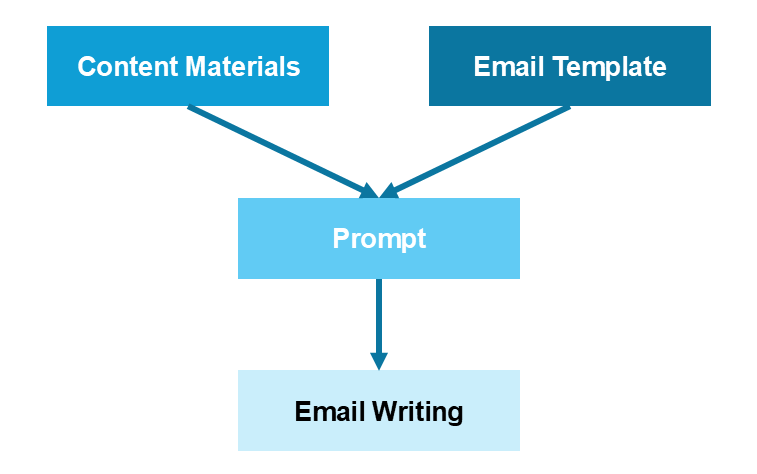
Why you need the three components: content materials, email template, and prompt
The key is to prepare each of the three components independently.
When you keep the “materials” separate, you can reuse the same setup for a different product simply by swapping the material content.
Using a “template” also helps prevent missing elements and standardizes the copy into a format your readers are familiar with. If you prepare templates by channel (email, social, etc.), you can switch formats simply by changing the template.
Content materials
As “materials,” prepare existing files such as sales decks used by your sales team or promotional seminar presentations owned by your marketing department. You may have materials in many formats—PowerPoint, Word, PDF, and more—and that’s fine as-is. One major benefit of using generative AI is that you can leverage your existing assets without reformatting them.
As a simplified example, we’ll use the sample text below as the content material.
Sample content material
This product is a premium toaster that transforms the everyday act of “toasting bread” into a high-value experience. Its greatest value is its ability to consistently deliver a perfectly toasted result—“crispy outside, moist inside”—regardless of who uses it. By combining steam functionality with temperature control, it automatically applies optimal heating based on the type of bread. This is a key strength and a major differentiator from typical toasters. Key features include steam heating, bread-type modes, and automatic temperature control. The price range is in the ¥20,000–¥30,000 range. The target customer is a dual-income woman in her early 40s who wants to improve her quality of life despite a busy schedule. Her challenge is that she’s not satisfied with inexpensive toasters and wants a compelling reason to justify a higher price.
Campaign information: We are currently running a free 6-month monitor program, limited to 30 people.
Email template
By using a template, you can match the email format to the style your audience is used to reading. If you prepare additional templates, you can also create copy for other channels such as social media with ease.
In a template, it’s important to clearly distinguish the “fixed parts” you won’t change from the “variable parts” that will be changed based on the materials and prompt instructions. By using the symbol {}, commonly used in programming to indicate variable elements, you can clearly show the AI “what should be rewritten.” This is an effective technique for preventing unintended output.
Here, as a simplified example, we’ll use the sample text email format below.
Template sample
Subject: [Proposal] {A specific subject line that captures the target’s interest and clearly communicates the benefit}
Body:
Dear {Customer Name},
This is the online shop team at XX Company.
{Empathy opener: A message that resonates with the target’s likely day-to-day concerns and frustrations}
{Problem statement: What happens if the issue remains unsolved, or why it’s hard to resolve}
■{Value headline 1: The product’s biggest feature in one line}
{Value body 1: Based on product info, explain why that feature benefits the target}
■{Value headline 2: How it differs from competitors}
{Value body 2: Use technical rationale and specific specs to build credibility}
[Offer]
{Offer details: Include any campaign info or benefits from the materials. If none, summarize the product’s appeal.}
▼ Learn more / Purchase here
{URL}
Because busy days deserve the best quality.
{Customer Name}, we look forward to serving you.
Email-writing prompt
Create a prompt to instruct generative AI.
Dummy
# Input
## Content material (product information)
[Note: Paste the “Sample content material” here]
## Email template
[Note: Paste the “Template sample” here]
# Context
## Role
You are an excellent marketing copywriter.
Please write a promotional email that moves the target emotionally and prompts action (a click).
# Instructions
## Task
Refer to the attached “product information” and focus on identifying the “target’s pain points” and the “product’s differentiation (strengths).”
Based on that, write the email copy.
## Constraints
• Avoid an overly salesy tone; write with a tone and manner that empathizes with the target.
• For the “empathy opener,” imagine the persona’s lifestyle context from the attached materials and write with concrete details.
Workflow for creating promotional emails with generative AI
1
Prepare your materials
Gather existing files as-is, such as internal “product planning PDFs” and “past seminar PPTs.” Prepare the template in the same way.
2
Upload to generative AI
Use the “paperclip (attachment)” icon in tools like ChatGPT to upload files directly.
(In this column, for simplicity, we paste the content as text into the prompt.)
3
Enter the prompt
Send the prompt.
(In this column, we copy and paste the sample prompt above and submit it.)
In real work, keep a human review step
In actual operations, you don’t use AI-generated copy as-is. People still handle the following:
- Whether anything poses legal risk
- Whether it matches the brand tone
- Whether numbers and product names are accurate
This helps ensure the quality of company communications and avoid risk.
Benefits of using generative AI for promotional email creation
Using generative AI to write emails can deliver four key benefits.
- Reduce time spent reading and reworking source materials
- Reduce time spent drafting email copy
- Prevent inconsistency in format and tone
- Reduce dependency on individuals
Try applying this approach to your own work.
Build prompt skills through practice to boost both efficiency and quality
With the approach introduced here, you can improve both efficiency and quality in your work. When you find yourself thinking “This is inefficient” or “This task is complex,” try proactively using generative AI in your marketing practice.
“Generative AI for Work” column series
| ・ What kinds of work can generative AI help with? How to choose the right “areas” and “methods” to maximize impact |
| ・ A roadmap for successful generative AI adoption: How to build the “mechanisms” that transform operations |
| ・ How to write prompts that get the answers you want: don’t ask “questions”—communicate “specifications.” |
| → Dramatically Boost Marketing Productivity: Copy-and-Paste Persona & Email Prompt Examples |
Free consultation—feel free to reach out.
Author
Taiitsu Enari
Worked in digital marketing at Sony, Nissan, MSD, and more, consistently focused on the field. Led strategy development and executed lead-generation initiatives including corporate website builds, SEO, search ads, and email marketing, as well as inside sales operations. Also has overseas assignment experience.